Skip to content

The Most Trusted Home Inspector Memphis TN Serving Your Home Inspection Needs

Call Us: (901) 609-7555
FacebookTwitterLinkedinYouTubePinterest
In-House Inspections LLC
Home Inspector Memphis TN
In-House Inspections LLCIn-House Inspections LLC
  • Home
  • About Us
    • Meet The Team
    • 100% Guarantee
    • Home Inspection Cost
  • Our Services
    • Memphis Home Inspector
    • Memphis Home Buyers Inspection
    • Memphis Home Sellers Inspection
    • Memphis Builder’s Warranty Inspection
  • Reviews
  • Sample Inspection Report
  • Service Area
    • Home Inspection In Memphis TN
    • Home Inspection Arlington TN
    • Home Inspection Shelby TN
    • Home Inspection Fayette TN
  • Schedule Now
  • Contact
  • Information
    • FAQs
    • Home Inspection Checklist
    • Avoid The Blind Home Inspector
    • Inspection Videos
    • Home Warranty Insurance
  • Home
  • About Us
    • Meet The Team
    • 100% Guarantee
    • Home Inspection Cost
  • Our Services
    • Memphis Home Inspector
    • Memphis Home Buyers Inspection
    • Memphis Home Sellers Inspection
    • Memphis Builder’s Warranty Inspection
  • Reviews
  • Sample Inspection Report
  • Service Area
    • Home Inspection In Memphis TN
    • Home Inspection Arlington TN
    • Home Inspection Shelby TN
    • Home Inspection Fayette TN
  • Schedule Now
  • Contact
  • Information
    • FAQs
    • Home Inspection Checklist
    • Avoid The Blind Home Inspector
    • Inspection Videos
    • Home Warranty Insurance

Tag Archives: attic ventilation problems

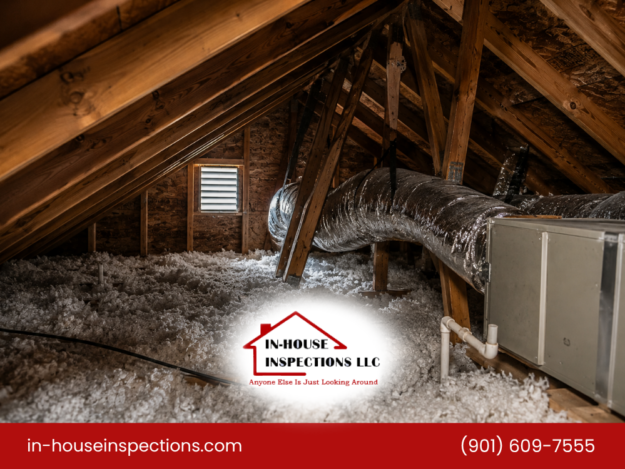
Attic insulation and HVAC ductwork inspection

West Tennessee Attic Inspection August | In-House Inspections LLC

Blog, PremiumBy In-House Inspections LLCAugust 28, 2026Leave a comment

What Your Attic Is Trying To Tell You (And Why August In West Tennessee Is The Best Time To Listen) Nobody wants to go into their attic in August. In Somerville, that space above your ceiling can hit 150 degrees on a hot summer afternoon — it’s dark, it’s cramped, and it’s not the kind…

Attic insulation and HVAC ductwork inspectionWhat Your Attic Is Trying To Tell You (And Why August In West Tennessee Is The Best Time To Listen)

Nobody wants to go into their attic in August. In Somerville, that space above your ceiling can hit 150 degrees on a hot summer afternoon — it’s dark, it’s cramped, and it’s not the kind of place you linger.

But your attic is also one of the most information-rich spaces in your entire home. What’s happening up there right now — in the hottest, most punishing weeks of the West Tennessee summer — tells the story of how your home is actually performing. And the problems you ignore in August have a way of becoming expensive surprises in October.

Bill Bond has inspected hundreds of homes across Fayette County and West Tennessee. When something is wrong with a home, the attic usually already knew about it. Here’s what to look for — and what it means.

Why August Exposes Attic Problems That Other Seasons Hide

Heat is a revealer. When your attic is running at 130, 140, or 150 degrees, it amplifies every vulnerability in your home’s building envelope. Inadequate insulation becomes dramatically more obvious in its energy cost. Ventilation failures that seemed minor in March show their true impact in August. Moisture that migrated up during spring rains has had months to grow, stain, or damage.

West Tennessee’s climate makes this especially pronounced. Somerville and the surrounding Fayette County area sit in a hot-humid climate zone — ASHRAE Zone 3A. That classification means your home faces challenges from both directions: summer heat and humidity pushing in from outside, and conditioned, moisture-bearing air from inside wanting to escape upward. Your attic sits at the intersection of both.

Ventilation: The Single Most Important Factor In Attic Health

In West Tennessee, the most common ventilation failures Bill sees are:

Blocked soffit vents – These are the small intake vents under your roof overhang. They pull outside air in at the low point, which then exhausts through ridge vents or gable vents at the top. When insulation is pushed against them or debris accumulates, the entire ventilation circuit breaks down. Hot, humid air stagnates. Attic temperatures spike. Roof decking bakes.

Insufficient exhaust – Many older homes in Fayette County were built with gable vents only — a passive system that worked adequately for its era but is undersized by today’s standards. If your home doesn’t have a ridge vent running the length of the peak, you may be losing a significant amount of ventilation capacity.

Bath and kitchen fans exhausting into the attic – This shows up in inspection after inspection. A bathroom exhaust fan is supposed to carry warm, humid air outside. When it’s vented into the attic instead, you’re pumping conditioned moisture directly into a space that’s already fighting humidity. Over time, this creates exactly the conditions mold needs to thrive.

Residential attic insulation and air ductsInsulation: What’s Enough, And What’s Not

In a Somerville home, the Department of Energy recommends R-38 to R-60 insulation in the attic — roughly 10 to 16 inches of blown fiberglass or cellulose. In many older Fayette County homes, Bill finds R-19 or less, installed decades ago and never updated.

The impact is direct and measurable. Under-insulated homes work their HVAC systems harder during hot West Tennessee summers, driving up utility costs and shortening equipment life. They’re also harder to sell — buyers who are aware of energy efficiency are paying attention, and it shows up in home inspection reports.

Moisture And Mold: August Tells The Truth

If there’s been a roof leak — active or past — your attic knows. In August, after months of heat and humidity, moisture damage is at its most visible. Staining on roof decking and rafters. Dark discoloration at sheathing seams. Mold growth around penetrations or in low-ventilation corners.

Not all discoloration is active mold — some is simply old water staining. But the distinction requires trained eyes, and mold in an attic is a health concern and a structural concern. In a real estate transaction, it’s a negotiating issue.

What A Home Inspector Sees That You Don’t

A professional home inspection of the attic documents insulation depth and condition, evaluates ventilation adequacy, inspects visible structural components (rafters, sheathing, collar ties), checks exhaust fan terminations, looks for signs of past or active moisture intrusion, and flags any evidence of pest activity.

That documentation matters — whether you’re maintaining your current home, preparing to sell, or evaluating a home before you buy. 

Call (901) 609-7555 or visit https://in-houseinspections.com/ to book online today!

© Copyright 2026 In-House Inspections LLC
All Rights Reserved | Created By: THE SAVVY INSPECTOR
Go to Top
Skip to content
Open toolbar Accessibility Tools

Accessibility Tools

  • Increase TextIncrease Text
  • Decrease TextDecrease Text
  • GrayscaleGrayscale
  • High ContrastHigh Contrast
  • Negative ContrastNegative Contrast
  • Light BackgroundLight Background
  • Links UnderlineLinks Underline
  • Readable FontReadable Font
  • Reset Reset